

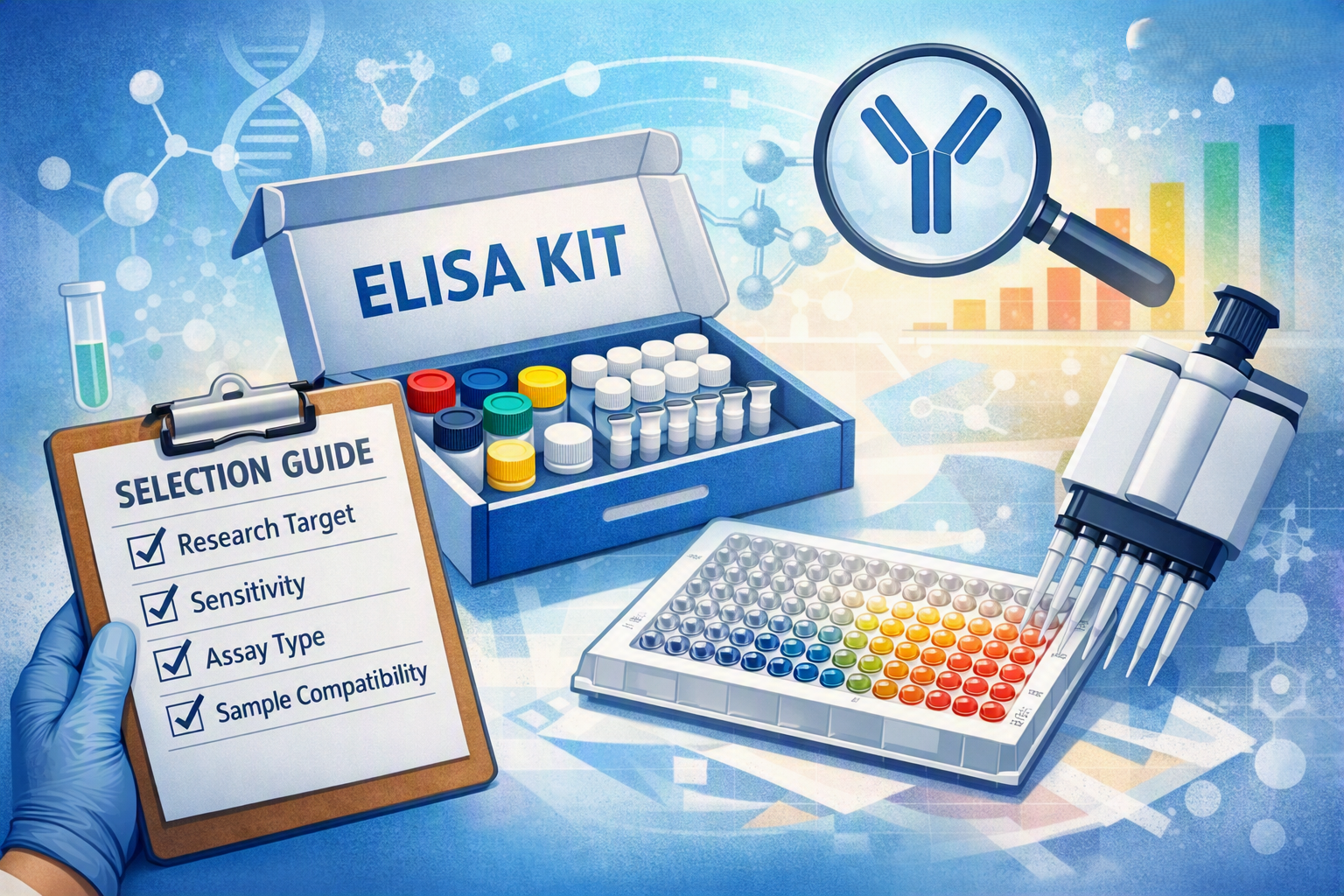
Choosing the right ELISA kit (Enzyme-Linked Immunosorbent Assay kit) is an important step in obtaining accurate, reproducible, and meaningful research results. With hundreds of ELISA kits available for different biomarkers, species, sample types, and applications, selecting the most suitable kit can sometimes be challenging.
A good ELISA kit should not only detect your target analyte but should also provide the appropriate sensitivity, specificity, detection range, sample compatibility, and reproducibility required for your research.
What Is an ELISA Kit?
ELISA is an immunoassay technique used to detect and quantify specific proteins, peptides, hormones, antibodies, antigens, and other biological molecules in samples.
Most ELISA kits use an antigen-antibody interaction combined with an enzyme-based detection system. Depending on the assay design, the resulting signal can be measured using a microplate reader, commonly at a wavelength such as 450 nm for HRP/TMB-based assays.
Identify Your Target Analyte
The first and most important step is to clearly identify what you want to measure. Your target could be:
- Cytokines
- Chemokines
- Growth factors
- Hormones
- Enzymes
- Receptors
- Antibodies
- Biomarkers
- Signaling proteins
- Therapeutic proteins
- Disease-related protein
Before purchasing a kit, confirm the exact target name and alternative names or synonyms.
For example, a protein may have several names used in scientific literature. BioString product pages often provide alternative names along with the target information, making it easier to confirm that you are selecting the correct analyte
Check the Species or Biological Source
Species compatibility is one of the most important factors when selecting an ELISA kit. ELISA kits may be designed specifically for:
- Human
- Mouse
- Rat
- Bovine
- Canine
- Feline
- Porcine
- Rabbit
- Other experimental species
- Universal or cross-species applications
For example, BioString offers separate categories for Human, Mouse, Rat, Bovine, and other ELISA kits, allowing researchers to select products according to their experimental model.
Compare Sensitivity and Detection Range
Two of the most important specifications on an ELISA kit datasheet are:
Sensitivity : Sensitivity indicates the lowest concentration of analyte that can be reliably detected under the specified assay conditions.
Detection or Assay Range: The detection range indicates the concentration interval over which the assay can provide quantitative results.
Common Mistakes to Avoid When Choosing an ELISA Kit
- Choosing based only on price
- Ignoring species compatibility
- Not checking the detection range
- Ignoring sample compatibility
- Not reviewing cross-reactivity
- Choosing the wrong ELISA format
Why Choose BioString ELISA Kits?
BioString offers a broad range of ELISA and assay products covering different research targets and species. Its online catalog includes hundreds of ELISA products, including Human, Mouse, Rat, Bovine, Universal, Multiplex, and PK ELISA categories.
The product specifications provide important information such as sensitivity, assay range, sample type, detection method, reaction time, and storage conditions, helping researchers evaluate whether a particular kit fits their experimental requirements.
BioString also offers custom ELISA development for researchers who require assays tailored to specific research applications.