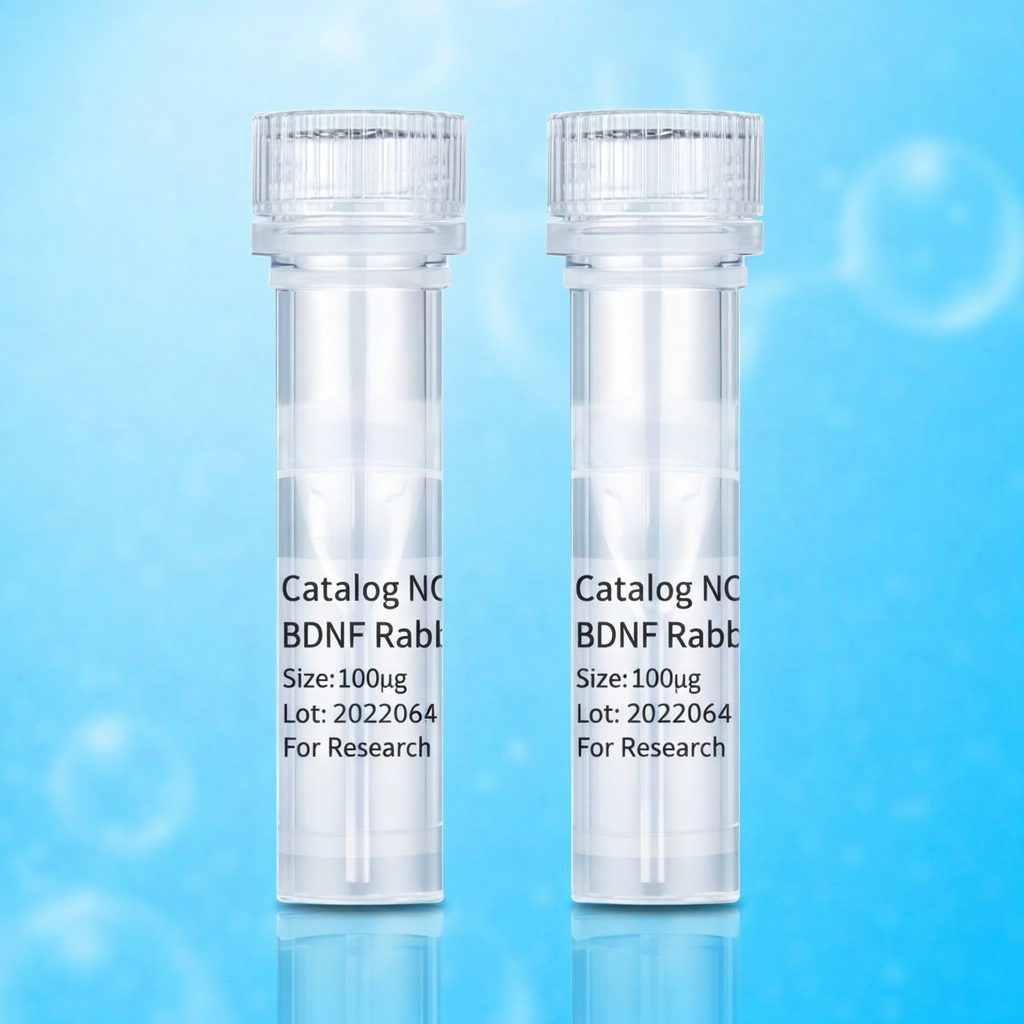
|
Tubulin Beta Antibody |
|
Description |
Rabbit Polyclonal Antibody To Tubulin beta |
|
Mol.Wt |
55kDa(Observed); 50kD(Calculated). |
|
Uniprot |
P07437 |
|
Application |
WB 1:1000-1:3000, IHC 1:50-1:200, IF/ICC 1:100-1:500 |
|
Clonality |
Polyclonal |
|
Specificity |
Tubulin beta Antibody detects endogenous levels of total Tubulin beta. |
|
Conjugate |
Unconjugated. |
|
Purification |
The antiserum was purified by peptide affinity chromatography using SulfoLink™ Coupling Resin. |
|
Storage |
Rabbit IgG in phosphate buffered saline , pH 7.4, 150mM NaCl, 0.02% sodium azide and 50% glycerol. Store at -20 °C. Stable for 12 months from date of receipt. |
|
Alternative Name |
TUBB3, CDCBM, Beta III Tubulin, Class III beta-tubulin, TUBB4, Tubulin, beta 3, Tubulin beta-III, Tubulin beta-3 chain, Tubulin beta-4 chain, Tubulin, beta 3 class III, CFEOM3A |
|
Immunogen |
A synthesized peptide derived from human Tubulin beta. |
|
Gene(ID) |
TUBB(203068) |
|
Uniprot |
P07437(TBB5_HUMAN) |
|
Expression |
P07437 TBB5_HUMAN: Ubiquitously expressed with highest levels in spleen, thymus and immature brain. |
|
Description |
TUBB3 Tubulin is the major constituent of microtubules. It binds two moles of GTP, one at an exchangeable site on the beta chain and one at a non-exchangeable site on the alpha-chain. TUBB3 plays a critical role in proper axon guidance and mantainance |
|
Subcellular Location |
Cytoplasm>Cytoskeleton. |
|
Tissue Specificity |
Ubiquitously expressed with highest levels in spleen, thymus and immature brain. |
|
Family & Domains |
The highly acidic C-terminal region may bind cations such as calcium. Belongs to the tubulin family. |
|
Function |
Tubulin is the major constituent of microtubules. It binds two moles of GTP, one at an exchangeable site on the beta chain and one at a non-exchangeable site on the alpha chain. |
|
PTMs |
Some glutamate residues at the C-terminus are polyglutamylated, resulting in polyglutamate chains on the gamma-carboxyl group. Polyglutamylation plays a key role in microtubule severing by spastin (SPAST). SPAST preferentially recognizes and acts on microtubules decorated with short polyglutamate tails: severing activity by SPAST increases as the number of glutamates per tubulin rises from one to eight, but decreases beyond this glutamylation threshold. Some glutamate residues at the C-terminus are monoglycylated but not polyglycylated due to the absence of functional TTLL10 in human. Monoglycylation is mainly limited to tubulin incorporated into axonemes (cilia and flagella). Both polyglutamylation and monoglycylation can coexist on the same protein on adjacent residues, and lowering glycylation levels increases polyglutamylation, and reciprocally. The precise function of monoglycylation is still unclear (Probable). |