

| Methanol Gradient Grade | |
| Synonym(s) | Methyl alcohol |
| Grade | Gradient Grade |
| Technique(s) | HPLC: suitable, immunofluorescence: suitable |
| Assay | ≥99.9% |
| Quality Segment | 100 |
| vapor density | 1.11 (vs air) |
| vapor pressure | 410 mmHg ( 50 °C), 97.68 mmHg ( 20 °C) |
| form | Liquid |
| autoignition temp | 725 °F |
| expl. lim | 36 % |
| impurities | KMnO4 red. matter (as O), in accordance, ≤0.0005% free alkali (as NH3), ≤0.0005% non-volatile matter, ≤0.001% acetaldehyde, ≤0.001% acetone (GC), ≤0.001% formaldehyde, ≤0.02% water (Karl Fischer), ≤1 ppb fluorescence (quinine) at 254 nm, ≤1 ppb fluorescence (quinine) at 365nm |
| evapn. residue | <0.0003% |
| color | APHA: ≤10 |
| refractive index | n20/D 1.329 (lit.) |
| bp | 64.7 °C (lit.) |
| mp | −98 °C (lit.) |
| density | 0.791 g/mL at 25 °C (lit.) |
| HPLC-gradient | ≤2 mAU at 230 nm, ≤5 mAU at 254 nm |
| absorption | in accordance |
| UV absorption | λ: 210 nm Amax: 0.50, λ: 220 nm Amax: 0.30, λ: 230 nm Amax: 0.15, λ: 235 nm Amax: 0.10, λ: 240 nm Amax: 0.05, λ: 260 nm Amax: 0.01, λ: 400 nm Amax: 0.01 |
| SMILES string | CO |
| application(s) | food and beverages |
| format | neat |
| InChI | 1S/CH4O/c1-2/h2H,1H3 |
| InChI key | OKKJLVBELUTLKV-UHFFFAOYSA-N |
| Pack Size | 2.5 LT | 1 LT | 100 ML |
| Methanol Gradient Grade for HPLC | |
| Synonyms | Methanol |
| Appearance | Colourless liquid. |
| Solubility | Miscible in water. |
| Density | 0.792 g/cm3 at 25°C |
| Boiling Point | 64.7°C. |
| Flash Point | 9.7°C. |
| Viscosity | 0.545 cP @ 25°C. |
| Odour | Sweet and pungent. |
| Purity | 99.80%. |
| Acidity (pKa) | 15.5. |
| Refractive Index | 1.329 nD. |
| Storage | Store in a cool and dry place. |
| Pack Size | 2.5 LT |
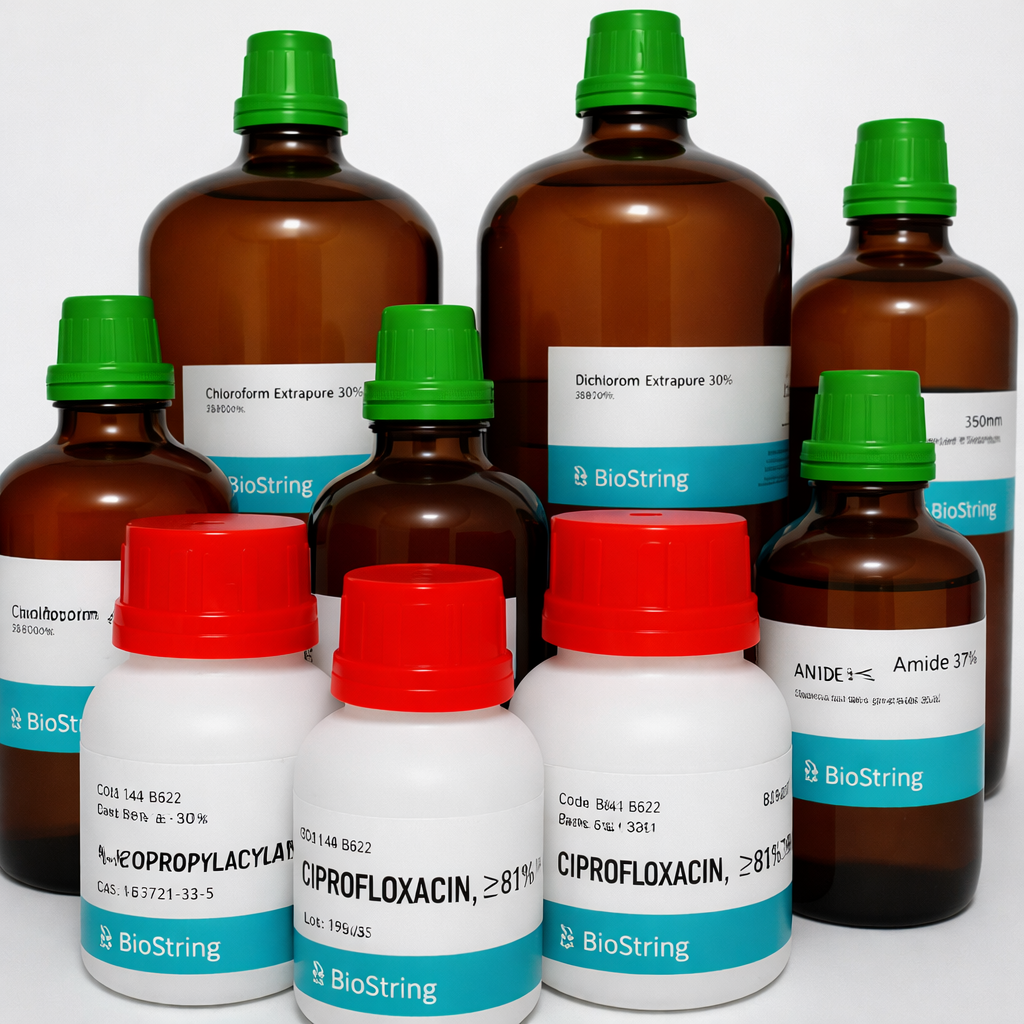
Methanol Gradient Grade
CAS No.: 67-56-1
| Catalouge No | BSCHM-035M |
| Mol. Formula | CH3OH |
| Mol. Weight | 32 |
| Size | 2.50 L |
| Price | POR |
Thermochemical conversion of methanol to C2-C10 hydrocarbons in the presence of shape-selective zeolites has been reported. Its oxidation on Ru-Pt catalyst system by ruthenium ad-atoms has been proposed.
Methanol (MeOH) has been used as an eluent in the HPLC estimation of malondialdehyde in plasma, which is an indicator of oxidative stress. It may be used in the following studies:
- Colony forming unit-fibroblast assay of bone marrow mononuclear cells.
- As solvent for the preparation of extracts of hyphae of Aspergillus for the estimation of gliotoxin by reversed phase-HPLC
- Immunofluorescence studies
- To compose eluent for the ion-pair reverse-phase HPLC isolation of nucleotides and their decomposition products