

| EGF Protein, Human | |
| Appearance | Lyophilized powder |
| Endotoxin Level | <1 EU/μg, determined by LAL method. |
| Tag | Tag Free |
| Accession | P01133-1 (N971-R1023) |
| Gene ID | 1950 [NCBI] |
| Synonyms | EGF; Alternative Protein EGF; Epidermal Growth Factor; Beta-Urogastrone; Pro-Epidermal Growth Factor; HOMG4; Epidermal Growth Factor (Beta-Urogastrone); URG |
| AA Sequence | NSDSECPLSHDGYCLHDGVCMYIEALDKYACNCVVGYIGERCQYRDLKWWELR |
| Predicted Molecular Mass | 6.2 kDa |
| Molecular Weight | Approximately 6-11 kDa, based on SDS-PAGE under reducing conditions, due to the glycosylation. |
| Purity | ≥ 95%, as determined by reducing SDS-PAGE. |
| Shipping | Room temperature in continental US; may vary elsewhere. |
| Reconstitution | It is not recommended to reconstitute to a concentration less than 100 μg/mL in ddH2O. For long term storage it is recommended to add a carrier protein (0.1% BSA, 5% HSA, 10% FBS or 5% Trehalose). |
| Shipping | Room temperature in continental US; may vary elsewhere. |
| Background | EGF Protein emerges as a potent stimulator of the growth of diverse epidermal and epithelial tissues in both in vivo and in vitro environments, along with fostering the proliferation of specific fibroblasts in cell culture. This multifaceted protein also acts as a magnesiotropic hormone, driving magnesium reabsorption in the renal distal convoluted tubule through the engagement of EGFR and activation of the magnesium channel TRPM6. Notably, EGF Protein possesses the capability to induce neurite outgrowth in motoneurons of the pond snail Lymnaea stagnalis in vitro. Its molecular interactions include binding to EGFR, thereby promoting EGFR dimerization, and interacting with RHBDF2, suggesting involvement in diverse cellular processes. Furthermore, EGF Protein engages with RHBDF1, potentially influencing the retention of EGF in the endoplasmic reticulum and regulating its degradation through endoplasmic reticulum-associated degradation (ERAD). |
| Validated Images |
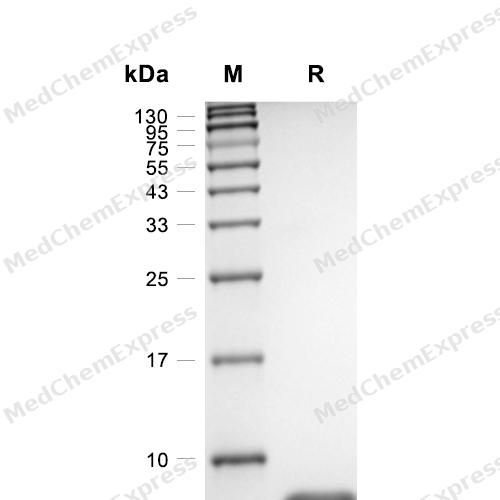
≥ 95%, as determined by reducing SDS-PAGE. 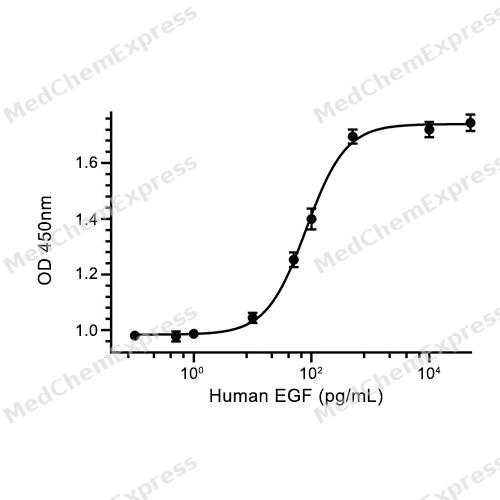
Measured in a cell proliferation assay using Balb/3T3 mouse embryonic fibroblast cells.The ED50 for this effect is 53.08 pg/mL, corresponding to a specific activity is 1.88×10⁷ units/mg. |
EGF Protein
| Catalogue No | BSRP-054 |
| Host | Human |
| Source | E. coli |
| Applications | - |
| Size | 2 μg | 10 μg | 50 μg | 100 μg | 250 μg | 500 μg |
| Price | POR |
EGF proteins act as potent stimulators of growth in a variety of epidermal and epithelial tissues in both in vivo and in vitro settings, while promoting the proliferation of specific fibroblasts in cell culture. This multifaceted protein also acts as a magnesium stimulating hormone, driving magnesium reabsorption in the renal distal tubule through engagement of EGFR and activation of the magnesium channel TRPM6. EGF Protein, Human is the recombinant human-derived EGF protein, expressed by E. coli , with tag free.
- Lyophilized from a 0.22 μm filtered solution of 20 mM PB, 150 mM NaCl, pH 7.4.
- Lyophilized from a 0.22 μm filtered solution of 10 mM PB, 200 mM NaCl, pH 7.0.
- Lyophilized from a 0.22 μm filtered solution of 50 mM Tris-HCl, 200 mM NaCl, pH 8.0.
- Lyophilized from a 0.22 μm filtered solution of PBS, pH 7.4, 5% trehalose, 5% mannitol, 0.01% Tween 80.
- Lyophilized from a 0.22 μm filtered solution of PBS, pH 7.4, 8% trehalose.
- Lyophilized from a 0.22 μm filtered solution of 20 mM Tris-HCl, 200 mM NaCl, pH 8.0.