

| Feature | Specifications |
| Main Functions | Isolation miRNA and other small RNA molecules (18nt), from cultured cells and various animal and human tissues, using MagZol reagent and column |
| Applications | RT-PCR, Northern Blot, poly A+purification, nucleic acid protection and in vitro translation |
| Purification method | Mini spin column |
| Purification technology | Silica technology |
| Process method | Manual (centrifugation or vacuum) |
| Sample type | Animal tissues, adherent cells, suspension cells, bacteria, etc |
| Sample amount | Eukaryotic culture cells: ≤ 10^7, Animal tissue:<100mg, Yeast culture cells:<5 x10^7, Bacteria:<10^9 |
| Elution volume | ≥15μl |
| Time per run | ~40-70 minutes |
| Liquid carrying volume per column | 800µl |
| Binding yield of column | 100μg |
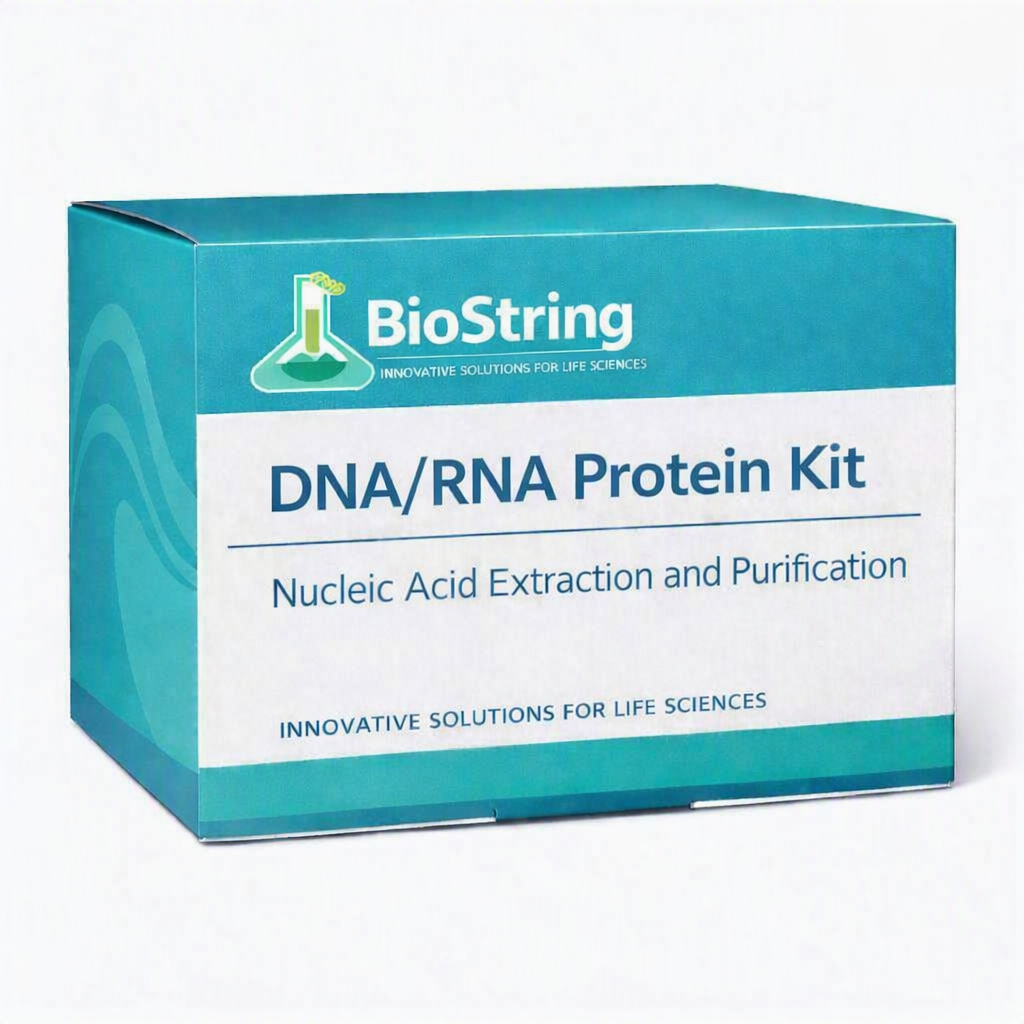
BioString Universal miRNA Kit
| Catalogue No | BS-RNA-019 |
| Product Name |
BioStringTM Universal miRNA Kit |
| Size | 50 Preps | 250 Preps |
| Price | POR |
The BioStringTM Universal miRNA Kit is designed for enrichment and purification of small RNA molecules including miRNA from tissues, cultured cells and other biological samples. The extraction workflow combines MagZol reagent chemistry with silica membrane purification to efficiently recover small RNA fractions.
Unlike conventional RNA purification methods that primarily recover large RNA molecules, the BioStringTM Universal miRNA Kit enables selective enrichment of small RNA molecules while also allowing purification of larger RNA fractions when required.
The kit combines phenol/guanidine-based lysis with silica membrane purification to enable efficient isolation of total RNA and enrichment of small RNA species including miRNA. During the lysis step, MagZol reagent disrupts cells and tissues while denaturing proteins and RNases, preserving RNA integrity. Subsequent chloroform extraction separates RNA into the aqueous phase while removing proteins, lipids, and most genomic DNA.
RNA purification is then achieved using silica membrane adsorption under ethanol-controlled binding conditions. When a higher ethanol concentration is applied, both large and small RNA molecules bind to the membrane, enabling recovery of total RNA including miRNA. Under lower ethanol conditions, larger RNA molecules preferentially bind to the first column while small RNAs remain in the flow-through. After increasing ethanol concentration, these small RNA species bind to a second column, allowing isolation of an miRNA-enriched fraction while preserving the larger RNA fraction for parallel purification.
BioStringTM Universal miRNA Kit was evaluated as a MagZol-based phenol / guanidine lysis and silica column purification workflow for recovery of total RNA including miRNA and other small RNA molecules.
Small RNA recovery was first evaluated using 50 mg chicken tissue samples, including liver, kidney, spleen, heart, muscle and lung. From 50 mg liver input, the miRNA-enriched small RNA fraction yielded 26.0–29.3 µg, with A260/280 values of 1.88–2.04. Other tested tissues produced small RNA yields of 8.4–19.2 µg under the tested conditions. Analysis by 3% agarose gel electrophoresis showed that the enriched small RNA fraction was mainly located below the 50 bp marker region, with no obvious large-RNA contamination observed in the tested lanes.
The larger RNA fraction was also recovered from the same animal tissue workflow. From 50 mg chicken liver input, large RNA yields were 169.2–181.5 µg, with A260/280 values of 2.07–2.11 and A260/230 values of 1.94–1.98. From 50 mg kidney and spleen inputs, large RNA yields were 103.7–103.9 µg and 127.6–127.7 µg, respectively. Lower-yielding tissues such as muscle and lung produced 6.7–11.2 µg and 32.4–34.8 µg RNA, respectively, while maintaining generally acceptable absorbance ratios under the tested conditions.
Plant sample compatibility was tested using 100 mg soybean, maize and paddy leaf inputs. The miRNA-enriched small RNA fraction produced yields of 14.2–16.1 µg from soybean leaves, 9.7–10.7 µg from maize leaves and 1.9–2.2 µg from paddy leaves. The A260/280 values varied by plant type, especially in soybean and maize small RNA fractions, indicating matrix-dependent purity differences in plant samples. Gel analysis still showed enrichment of small RNA mainly below the 50 bp region, supporting small RNA recovery from plant material under the tested conditions.
Large RNA recovery from plant samples was further evaluated using the same 100 mg inputs. From soybean leaf input, the larger RNA fraction yielded 72.34–81.02 µg, with A260/280 values of 2.19–2.20. Maize and paddy leaf inputs produced large RNA yields of 9.94–12.40 µg and 13.38–14.58 µg, respectively, with A260/280 values of approximately 2.06–2.12. Electrophoresis analysis showed clear larger RNA band patterns with little visible small-fragment carryover, supporting fractionated recovery of larger RNA after small RNA separation.
Together, these results support universal miRNA and RNA fractionation workflow for animal tissue, plant tissue and other biological samples where small RNA enrichment and larger RNA recovery are both required. The data are strongest for animal tissue small RNA enrichment and large RNA recovery, while plant small RNA results should be interpreted with attention to sample-specific inhibitor and pigment background.
MagZol Reagent should be stored at 2-8°C upon arrival. However, short-term storage (up to 24 weeks) at room temperature (15-25°C) does not affect its performance. The remaining kit components can be stored at room temperature (15-25°C) and are stable for at least 18 months under these conditions.