

| CD81 Rabbit Polyclonal Antibody | |
| Description | Rabbit Polyclonal Antibody |
| Conjugation | Unconjugated |
| Modification | Unmodified |
| Isotype | IgG |
| Clonality | Polyclonal |
| Form | Liquid |
| Storage | Store at 4°C short term. Aliquot and store at -20°C long term. Avoid freeze/thaw cycles. |
| Buffer | Liquid in PBS containing 50% glycerol, 0.5% protective protein and 0.02% New type preservative N. |
| Purification | Affinity purification |
| Gene Name | CD81 |
| Gene ID | 975 |
| SwissProt ID | P60033 |
| Alternative Names | CD81; TAPA1; TSPAN28; CD81 antigen; 26 kDa cell surface protein TAPA-1; Target of the antiproliferative antibody 1; Tetraspanin-28; Tspan-28; CD81 |
| Dilution Ratio | WB 1:500-1:2000,ICC/IF 1:50-1:200,ELISA 1:10000-1:20000 |
| Molecular Weight | 26kDa |
| Research Area | B_Cell_Antigen |
CD81 Rabbit Polyclonal Antibody
| Catalogue No | BSAB-255P |
| Host | Rabbit |
| Reactivity | Human, Mouse, Rat |
| Applications | WB,ICC/IF,ELISA |
| Size | 20μL | 50μL | 100μL | 200μL |
| Price | POR |
The protein encoded by this gene is a member of the transmembrane 4 superfamily, also known as the tetraspanin family. Most of these members are cell-surface proteins that are characterized by the presence of four hydrophobic domains. The proteins mediate signal transduction events that play a role in the regulation of cell development, activation, growth and motility. This encoded protein is a cell surface glycoprotein that is known to complex with integrins. This protein appears to promote muscle cell fusion and support myotube maintenance. Also it may be involved in signal transduction. This gene is localized in the tumor-suppressor gene region and thus it is a candidate gene for malignancies. Two transcript variants encoding different isoforms have been found for this gene. [provided by RefSeq, Jul 2014],function:May play an important role in the regulation of lymphoma cell growth. Interacts with a 16-kDa Leu-13 protein to form a complex possibly involved in signal transduction. May acts a the viral receptor for HCV.,PTM:Not glycosylated.,similarity:Belongs to the tetraspanin (TM4SF) family.,subunit:Plays a critical role in HCV attachment and/or cell entry by interacting with HCV E1/E2 glycoproteins heterodimer. Interacts directly with IGSF8.,tissue specificity:Hematolymphoid, neuroectodermal and mesenchymal tumor cell lines.,
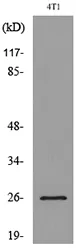
Western blot analysis of lysate from 4T1 cells, using CD81 Antibody
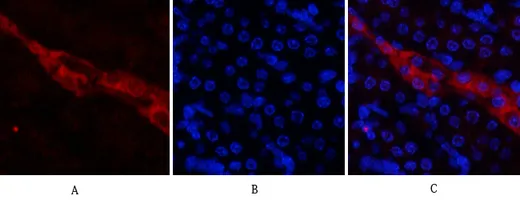
Immunofluorescence analysis of mouse-kidney tissue. 1,CD81 Polyclonal
Antibody(red) was diluted at 1:200(4°C,overnight). 2, Cy3 labled Secondary
antibody was diluted at 1:300(room temperature, 50min).3, Picture B: DAPI(blue
) 10min. Picture A:Target. Picture B: DAPI. Picture C: merge of A+B
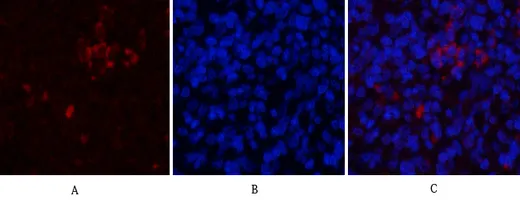
Immunofluorescence analysis of rat-spleen tissue. 1,CD81 Polyclonal Antibody(red
) was diluted at 1:200(4°C,overnight). 2, Cy3 labled Secondary antibody was
diluted at 1:300(room temperature, 50min).3, Picture B: DAPI(blue) 10min.
Picture A:Target. Picture B: DAPI. Picture C: merge of A+B
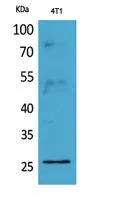
Western Blot analysis of 4T1 cells using CD81 Polyclonal Antibody. Antibody was
diluted at 1:2000. Secondary antibody was diluted at 1:20000
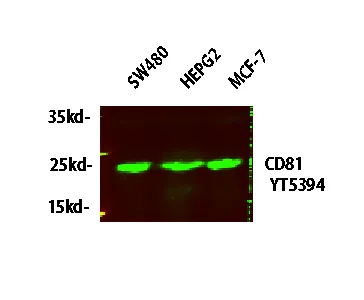
Western blot analysis of lysates from HT-29, NIH/3T3, and HepG2 cells, CD81 Rabbit
Polyclonal Antibody was diluted at 1:1000, 4° over night, secondary antibody was
diluted at 1:10000, 37° 1hour.