

| Siah-1/2 Rabbit Polyclonal Antibody - Details | |
| Description | Rabbit Polyclonal Antibody |
| Conjugation | Unconjugated |
| Modification | Unmodified |
| Isotype | IgG |
| Clonality | Polyclonal |
| Form | Liquid |
| Storage | Store at 4°C short term. Aliquot and store at -20°C long term. Avoid freeze/thaw cycles. |
| Buffer | Liquid in PBS containing 50% glycerol, 0.5% protective protein and 0.02% New type preservative N. |
| Purification | Affinity purification |
| Gene Name | SIAH1/SIAH2 |
| Gene ID | 6477/6478 |
| SwissProt ID | Q8IUQ4/O43255 |
| Dilution Ratio | WB 1:500-1:2000,IHC 1:100-1:300,ICC/IF 1:200-1:1000,ELISA 1:5000-1:20000 |
| Molecular Weight | 34kDa |
| Alternative Names | SIAH1; HUMSIAH; E3 ubiquitin-protein ligase SIAH1; Seven in absentia homolog 1; Siah-1; Siah-1a; SIAH2; E3 ubiquitin-protein ligase SIAH2; Seven in absentia homolog 2; Siah-2; hSiah2 |
| Research Area | p53;Ubiquitin mediated proteolysis;WNT;WNT-T CELL |
Siah-1/2 Rabbit Polyclonal Antibody
| Catalouge No | BSAB-231P |
| Host | Rabbit |
| Reactivity | Human, Mouse, Rat |
| Applications | WB,IHC,ICC/IF,ELISA |
| Size | 20μL | 50μL | 100μL | 200μL |
| Price | POR |
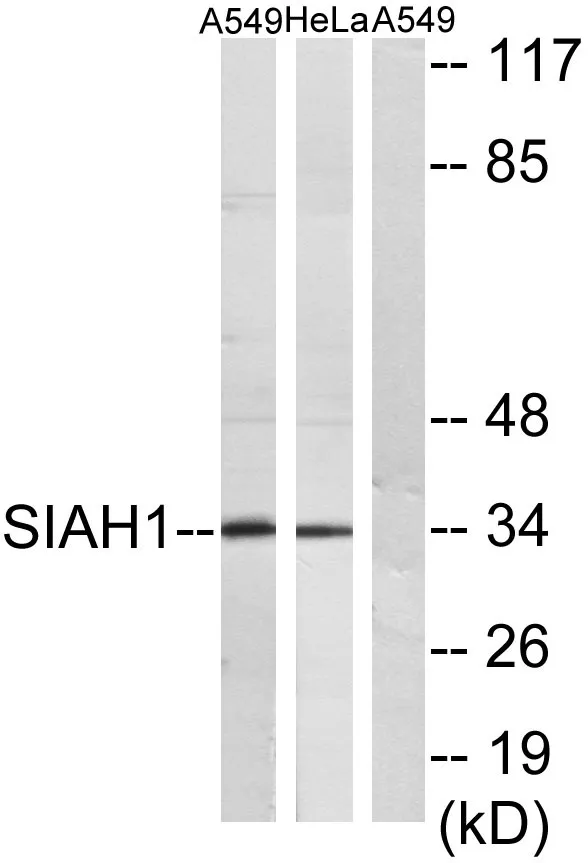
This gene encodes a protein that is a member of the seven in absentia homolog (SIAH) family. The protein is an E3 ligase and is involved in ubiquitination and proteasome-mediated degradation of specific proteins. The activity of this ubiquitin ligase has been implicated in the development of certain forms of Parkinson's disease, the regulation of the cellular response to hypoxia and induction of apoptosis. Alternative splicing results in several additional transcript variants, some encoding different isoforms and others that have not been fully characterized. [provided by RefSeq, Jul 2008],domain:The RING-type zinc finger domain is essential for ubiquitin ligase activity.,domain:The SBD domain (substrate-binding domain) mediates the homodimerization and the interaction with substrate proteins. It is related to the TRAF family.,function:E3 ubiquitin-protein ligase that mediates ubiquitination and subsequent proteasomal degradation of target proteins. E3 ubiquitin ligases accept ubiquitin from an E2 ubiquitin-conjugating enzyme in the form of a thioester and then directly transfers the ubiquitin to targeted substrates. Mediates E3 ubiquitin ligase activity either through direct binding to substrates or by functioning as the essential RING domain subunit of larger E3 complexes. Triggers the ubiquitin-mediated degradation of many substrates, including proteins involved in transcription regulation (MYB, POU2AF1, PML and RBBP8), a cell surface receptor (DCC), cytoplasmic signal transduction molecules (TIEG1 and NUMB), an antiapoptotic protein (BAG1), a microtubule motor protein (KIF22), a protein involved in synaptic vesicle function in neurons (SYP), a structural protein (CTNNB1) and SNCAIP. It is thereby involved in many cellular processes such as apoptosis, tumor suppression, cell cycle, axon guidance, transcription regulation, spermatogenesis and TNF-alpha signaling. Has some overlapping function with SIAH2. Induces apoptosis in cooperation with PEG3.,induction:May be induced by TP53/p53, suggesting that it may be required to modulate TP53 response. The relevance of such activity in vivo is however unclear and may not exist.,pathway:Protein modification; protein ubiquitination.,similarity:Belongs to the SINA (Seven in absentia) family.,similarity:Contains 1 RING-type zinc finger.,similarity:Contains 1 SIAH-type zinc finger.,subcellular location:Predominantly cytoplasmic. Partially nuclear.,subunit:Homodimer. Interacts with group 1 glutamate receptors GRM1 and GRM5. Interacts with DAB1, which may inhibit its activity. Interacts with UBE2E2. Interacts with PEG3 (By similarity). Component of some large E3 complex composed of UBE2D1, SIAH1, CACYBP/SIP, SKP1, APC and TBL1X. Interacts with UBE2I. Interacts with alpha-tubulin. Interacts with PEG10, which may inhibit its activity. Interacts with KHDRBS3.,tissue specificity:Widely expressed at low level. Down-regulated in advanced hepatocellular carcinomas