|
mGluR-2/3 Rabbit Polyclonal Antibody |
|
Description |
Rabbit Polyclonal Antibody |
|
Conjugation |
Unconjugated |
|
Modification |
Unmodified |
|
Isotype |
IgG |
|
Clonality |
Polyclonal |
|
Form |
Liquid |
|
Storage |
Store at 4°C short term. Aliquot and store at -20°C long term. Avoid freeze/thaw cycles. |
|
Buffer |
Liquid in PBS containing 50% glycerol, 0.5% protective protein and 0.02% New type preservative N. |
|
Purification |
Affinity purification |
|
Gene Name |
GRM2 |
|
Gene ID |
2912/2913 |
|
SwissProt ID |
Q14416/Q14832 |
|
Dilution Ratio |
WB 1:500-1:2000,IHC 1:100-1:300,ICC/IF 1:50-1:200,ELISA 1:10000-1:20000
Molecular Weight |
|
Molecular Weight |
100kDa |
|
Alternative Names |
GRM2; GPRC1B; MGLUR2; Metabotropic glutamate receptor 2; mGluR2; GRM3; GPRC1C; MGLUR3; Metabotropic glutamate receptor 3; mGluR3 |
|
Research Area |
Calcium;Neuroactive ligand-receptor interaction;Gap junction;Long-term potentiation;Long-term depression |
|
Background |
glutamate metabotropic receptor 2(GRM2) Homo sapiens L-glutamate is the major excitatory neurotransmitter in the central nervous system and activates both ionotropic and metabotropic glutamate receptors. Glutamatergic neurotransmission is involved in most aspects of normal brain function and can be perturbed in many neuropathologic conditions. The metabotropic glutamate receptors are a family of G protein-coupled receptors, that have been divided into 3 groups on the basis of sequence homology, putative signal transduction mechanisms, and pharmacologic properties. Group I includes GRM1 and GRM5 and these receptors have been shown to activate phospholipase C. Group II includes GRM2 and GRM3 while Group III includes GRM4, GRM6, GRM7 and GRM8. Group II and III receptors are linked to the inhibition of the cyclic AMP cascade but differ in their agonist selectivities. Two transcript variants encoding different isoforms have been found for this genefunction:Receptor for glutamate. The activity of this receptor is mediated by a G-protein that inhibits adenylate cyclase activity. May mediate suppression of neurotransmission or may be involved in synaptogenesis or synaptic stabilization.,similarity:Belongs to the G-protein coupled receptor 3 family.,subunit:Interacts with GRASP.,tissue specificity:Widely expressed in different regions of the adult brain as well as in fetal brain |
|
Validated Image |
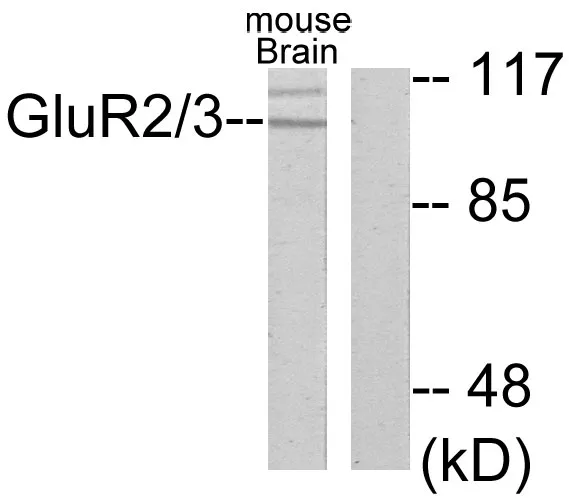
Western blot analysis of lysates from mouse brain, using mGluR2/3 Antibody. The lane on the right is blocked with the synthesized peptide.
|