

| Feature | Specifications |
| Main Functions | Isolation total RNA from 100-150mg stool sample |
| Applications | RT-PCR, Northern hybridization and other experiments |
| Purification method | Mini spin column |
| Purification technology | Silica technology |
| Process method | Manual (centrifugation or vacuum) |
| Sample type | Stool |
| Sample amount | 100-150 mg |
| Elution volume | ≥30μl |
| Time per run | ≤50 minutes |
| Liquid carrying volume per column | 100µg |
| Binding yield of column | 800µl |
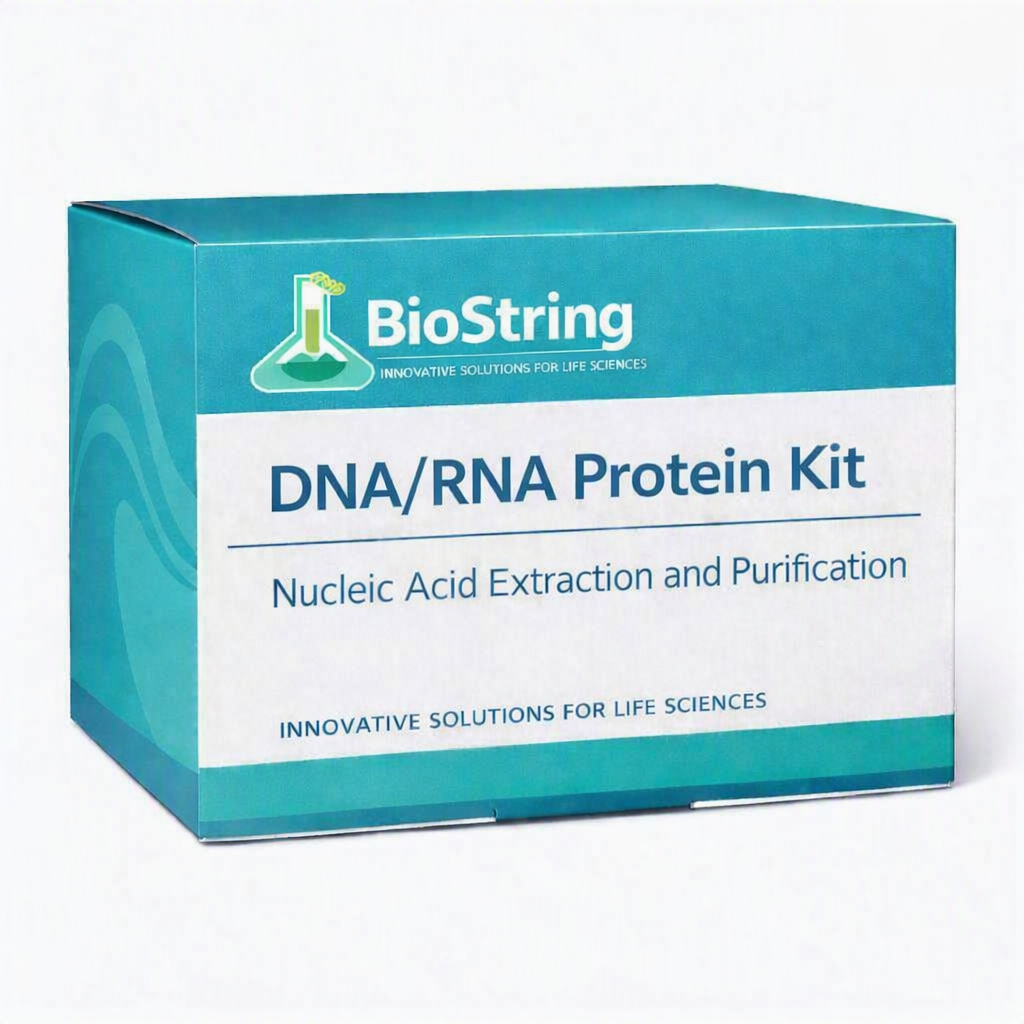
BioString Stool RNA Kit
| Catalogue No | BS-RNA-028 |
| Product Name |
BioStringTM Stool RNA Kit |
| Size | 50 Preps | 250 Preps |
| Price | POR |
Stool samples are increasingly used for non-invasive analysis of microbial gene expression and intestinal biology. Compared to DNA extraction, RNA preparation from stool samples presents additional challenges due to RNA instability, partial degradation and the presence of a wide range of inhibitory substances.
Stool samples typically contain polysaccharides, bile salts and other digestion-derived compounds that can interfere with RNA purification and downstream enzymatic reactions. At the same time, RNA molecules are more susceptible to degradation during sample processing, making both inhibitor control and RNA preservation critical for successful extraction.
The BioStringTM Stool RNA Kit is developed to address these challenges through a workflow combining mechanical disruption with optimized purification chemistry. The system is designed to reduce inhibitor background while maintaining RNA integrity during extraction from complex fecal matrices.
Stool samples are first subjected to bead-assisted mechanical disruption combined with chemical lysis to release total RNA from microbial cells within complex fecal matrices.
Following lysis, phase separation is performed using organic extraction to remove genomic DNA and impurities from the lysate. The resulting aqueous phase containing RNA is then subjected to purification.
Under optimized binding conditions, RNA is selectively adsorbed onto a silica membrane and purified through sequential washing steps to remove residual contaminants and inhibitors. Purified RNA is then eluted for downstream molecular analysis.
BioStringTM Stool RNA Kit was evaluated as a silica column-based RNA extraction workflow for stool and microbial samples. The workflow combines bead-assisted sample homogenization, SPL / PHC lysis, chloroform-based impurity removal, alcohol-free binding preparation, silica column purification, washing and RNase-free water elution. This design is intended to recover microbial or host-cell RNA from inhibitor-rich stool matrices while reducing carryover of stool-derived contaminants.
In stool sample testing, 300 mg stool input was homogenized with zirconia beads, lysis reagents and phenol / chloroform / isoamyl alcohol, followed by centrifugation. A 300 µL clarified supernatant was processed using the R4185 column workflow, and RNA was eluted in 70 µL RNase-free water. Across six replicate stool extractions, RNA yields were 57.92–74.38 µg, with A260/280 values of 1.99–2.07 and A260/230 values of 1.40–1.57 under the tested conditions. Agarose gel electrophoresis showed clear RNA band patterns without obvious degradation.
Microbial RNA recovery was further evaluated using concentrated Escherichia coli samples. A 300 µL bacterial suspension was processed through the same bead-assisted lysis and R4185 column purification workflow, with RNA eluted in 70 µL. Across six replicate bacterial extractions, RNA yields were 12.02–13.98 µg, with A260/280 values of 2.18–2.20 and A260/230 values of 1.74–2.15. Electrophoresis analysis showed clear RNA bands, supporting the use of the R4185 workflow for bacterial RNA recovery from stool-related or microbial sample contexts.
Together, these results support column-based stool RNA extraction workflow for laboratories that require RNA recovery from complex stool matrices and bacterial samples. For DNA-sensitive downstream applications such as RT-PCR, the optional on-column DNase digestion route described in the protocol can be used to further reduce residual genomic DNA background.